





Introduction
Gian Lorenzo Bernini — known in English as “Bernini” — is the soul of Roman Baroque. His work turned Rome into a theatrical stage where sculpture, architecture and light converse to move the visitor. At the heart of this spiritual metropolis, the Vatican concentrates an exceptional number of Bernini’s works: squares, basilicas, staircases and tombs all testify to a unified vision where spiritual power and mastery of the arts answer each other.
This article offers a detailed tour of Bernini’s main creations at the Vatican, giving exact addresses, opening hours, prices in euros and precise descriptions to best prepare your visit. You’ll also find practical information: how to reach the works, which areas require tickets, the visiting rules (dress code for the Basilica, security checks), and tips for photographing or simply feeling the work in its original space.
Bernini worked for popes such as Urban VIII and Alexander VII, leaving major interventions at the very heart of Christendom: the vast St. Peter’s Square, St. Peter’s Basilica and the adjacent palaces. His creations function as instruments of visual liturgy: the bronze baldachin that crowns the papal altar, the “Chair of Saint Peter” symbolizing Petrine authority, and papal tombs that mix realistic faces with funerary symbolism.
More than an inventory, this text aims to guide an on‑site reading: how to recognize Bernini’s hand, what surprises his architectural devices hold (optical illusion, dramatic use of light), and how to organize your visit so you don’t miss anything. Whether you love history, architecture, sculpture or are simply a curious traveler, get ready to discover the work of an artist who sculpted the Vatican’s visual narrative for centuries to come.
The colonnade of St. Peter’s Square (Piazza San Pietro)
The first encounter with Bernini’s monumental work at the Vatican inevitably takes place on Piazza San Pietro, in front of St. Peter’s Basilica. Address: Piazza San Pietro, 00120 Città del Vaticano. Designed between 1656 and 1667, this square is dominated by the famous colonnade that frames the space and directs the eye toward the façade and the basilica’s dome.
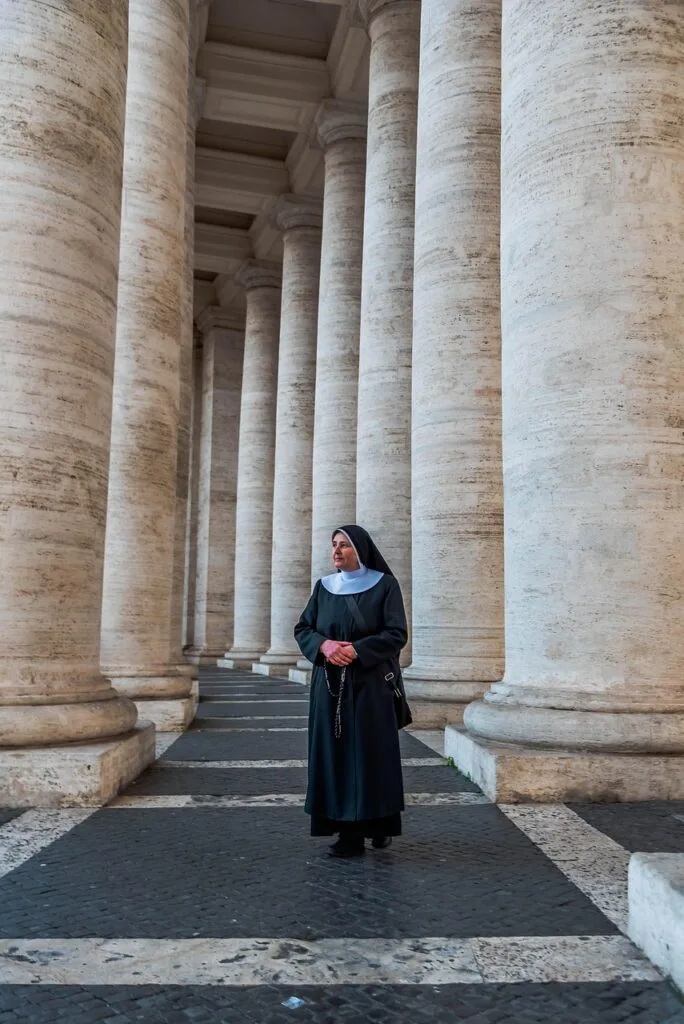
Bernini’s design consists of two vast semicircular colonnades that embrace the pilgrims: four rows of Doric columns form a portico creating a welcoming, embracing effect. Statistically, the colonnade is made up of 284 columns arranged in four rows and topped by around 140 statues of saints, executed by Bernini’s workshop and his contemporaries. The rhythm of the columns—their height and thickness—and the curved alignment produce a visual dynamic that amplifies the sense of procession: the faithful literally enter the sacred scene.
The square is freely accessible (free entry) and is open to the public most of the time: in practice, Piazza San Pietro is open 24 hours a day, but access may be restricted during papal audiences, ceremonies or works. Security checkpoints are located at the main entrance. It’s advisable to arrive early in the morning or late afternoon to enjoy soft light on the colonnade and avoid the midday crowds.
Visiting the square also means observing the dialogue between architecture and perspective: the curved colonnade stages the basilica as a focal point, and the stones still bear the marks of time and successive restorations. Here Bernini used architecture as a social actor — the square is not merely a backdrop, it organizes meetings, processions and papal ceremonies.
 Click here to book your guided tour of St. Peter’s Basilica
Practical information — St. Peter’s Square
- Address: Piazza San Pietro, 00120 Città del Vaticano
- Price: public access free of charge
- Opening hours: exterior area generally accessible 24/7; checks at the entrance depending on events (notably papal audiences).
- Tip: Respect barriers and signage during celebrations. Large crowds can cause delays at security checks.
The Baldacchino (Baldachin) and the dome of St. Peter’s Basilica
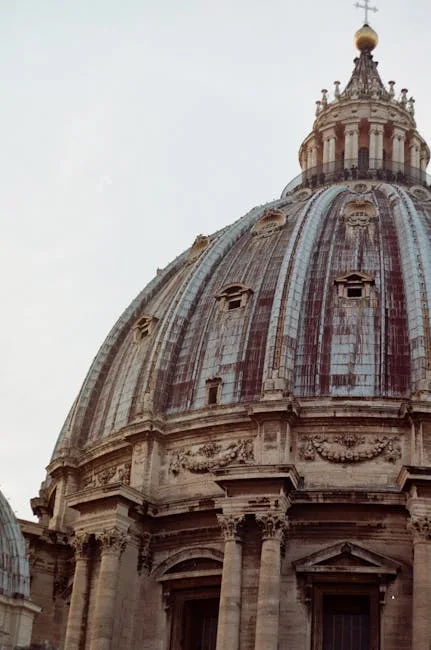
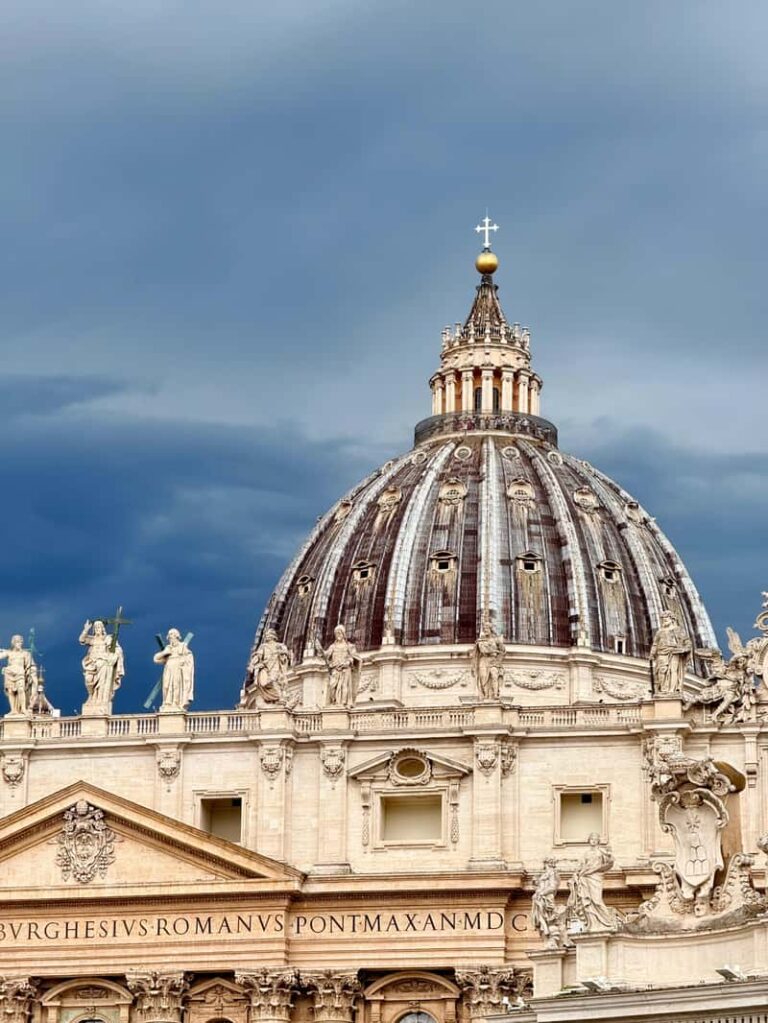
At the center of St. Peter’s Basilica, beneath the great dome drawn by Michelangelo but completed and interpreted by Bernini, stands the famous Baldacchino di San Pietro — the bronze baldachin crowning the papal altar. Basilica address: Basilica di San Pietro in Vaticano, Piazza San Pietro, 00120 Città del Vaticano. The baldachin, finished around 1633, measures nearly 29 meters high and rests on helical “Solomonic” columns — a stylistic choice that references ancient architecture and creates an upward movement.
The baldachin is made of bronze — part of which, by tradition, comes from the melting of the Pantheon’s chains — and is marked by Baroque ornament: vine leaves, angels, the Barberini papal emblems (bees) and flamboyant volutes. It is not merely decorative: it highlights and sanctifies the location of the papal altar, above what tradition holds to be the tomb of the Apostle Peter. Light filtering through the dome creates plays of shadow and gold that amplify the gilded reliefs.
Entering the basilica is free, but some accesses are ticketed: climbing the dome (the “cupola”) has two options. This lets you appreciate the Baldacchino from the upper gallery and observe the dome’s internal structure. Details:
- Climb by stairs (551 steps): about €8.
- Elevator + 320 steps climb: about €10.
- Dome opening hours: generally 8:00 – 18:00 (Apr–Sept) and 8:00 – 17:00 (Oct–Mar); last ascent 30 minutes before closing. Check on site as times can change for liturgical days.
- Entrance to the Basilica: free; basilica hours: 7:00–19:00 (Apr–Sept) / 7:00–18:30 (Oct–Mar), with variations for ceremonies).
To fully appreciate the Baldacchino, take time to stand beneath the dome, then move toward the side nave to study the details: reliefs, inscriptions, and the deliberately dramatic dialogue between the bronze structure and the surrounding stone.
Click here to climb the dome and visit St. Peter’s Basilica
See Bernini’s work at the Vatican on a structured visit
Three different ways to approach Bernini at the Vatican, depending on time and interest.
Choose a packed route (museums + Sistine + basilica), a route focused on the basilica and its tombs, or a visit oriented toward architecture and privileged access — each option highlights a different aspect of Bernini’s work: museum context, liturgical readability, or spatial perception in situ.
1. Vatican Museums, Sistine Chapel and Basilica
Full guided tour of the Vatican Museums, the Sistine Chapel and the Basilica with priority access via Bernini’s Scala Regia. Ideal to place the Baldacchino and the Chair of Saint Peter within their museum and liturgical context.
- ⏱️ Duration: 2.5 – 4 hours
- 🚩 Departure: Meeting point near the Vatican walls (varies by option)
- 📍 Route: Museums → Sistine Chapel → Basilica (access via Scala Regia)
- 🎧 Format: Small-group guided tour
- 🗣️ Languages: French, English, Spanish, Portuguese
2. Basilica, dome ascent and papal tombs
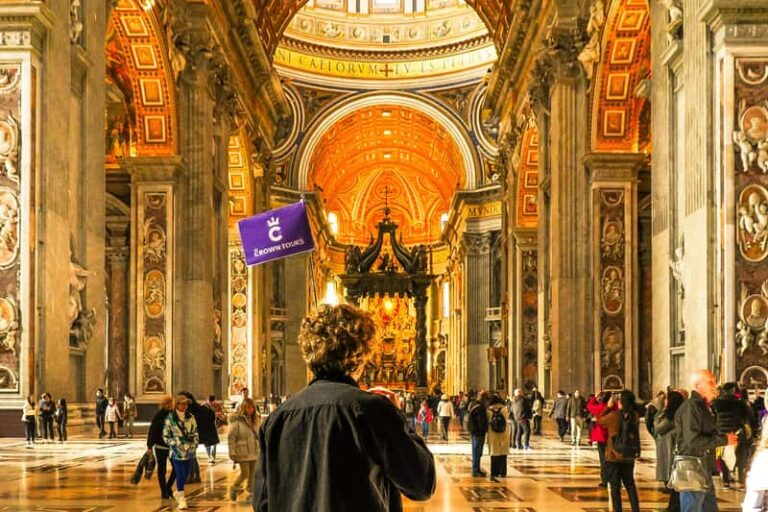
Focused on the basilica: the Pietà, the Baldacchino, the Cathedra Petri, climb the dome to admire the cupola and visit the papal tombs — perfect for those who want to combine liturgy, sculpture and panoramas.
- ⏱️ Duration: 1.5 – 2.5 hours
- 🎟️ Access: Basilica entry free; dome ascent paid (stairs/elevator)
- 💡 Highlight: Focus on the Baldacchino, the Chair of Saint Peter and the tombs of Urban VIII/Alexander VII
- 🚶 Format: Focused guided tour
- 🗣️ Languages: French, Italian, English, Spanish
The Cathedra Petri: the throne of the Holy Father
One of Bernini’s most symbolic masterpieces at the Vatican is the Cathedra Petri (the “Chair of Saint Peter”), installed in the apse of St. Peter’s Basilica. Located behind the high altar, on the liturgical axis, it is a synthesis of sculpture, architecture and light. The work was made between 1657 and 1666 and includes an ancient walnut chair (traditionally attributed to the apostle Peter), enclosed in a monumental gilded bronze reliquary designed by Bernini and his workshop.
The Cathedra Petri is visually supported by four large marble figures — the “Doctors of the Church” — who seem to bear the whole; above them, a large stained-glass window represents the Holy Spirit as a luminous dove. Bernini arranges the space so natural light pours onto the chair, creating a miraculous effect: the chair appears as a sacred object sustained by the energy of Heaven. The baroque effect is complete: sublime, theatrical and deeply narrative.
Location and visit: the Cathedra Petri is admired from the central nave of the basilica. As with the rest of the interior, access to this area is free, but the quality of the visit depends on the light (morning/late afternoon) and the relative calm of the basilica. Take time to observe the textures (gilded bronze, polychrome marble), the sculpted expressions and how Bernini integrates papal symbols.
Practical information for the Basilica (reminder):
- Address: Basilica di San Pietro in Vaticano, Piazza San Pietro, 00120 Città del Vaticano
- Entry: free
- Hours: 7:00–19:00 (Apr–Sept) / 7:00–18:30 (Oct–Mar) depending on the liturgical calendar
- Tips: Respect the dress code (shoulders, knees covered), mandatory security checks, possible long queues during major religious holidays.
Click here to discover the Pietà and the papal tombs

Papal tombs: Urban VIII and Alexander VII
Bernini also carved funerary monuments for popes, blending grandeur, theatricality and funerary symbolism. Two examples inside St. Peter’s Basilica are especially evocative: the funerary monument of Pope Urban VIII (Maffeo Barberini) and that of Pope Alexander VII (Fabio Chigi). These works trace the evolution of Baroque sensibilities in the treatment of power and death.
The monument to Urban VIII (made in the 1634–1647 period) glorifies Pope Barberini: it combines a glorified effigy, allegorical figures and a rich heraldic decoration (the Barberini bees appear everywhere). The whole ensemble illustrates the patron-artist–pontiff relationship: Bernini celebrates his patron with a triumphant staging that emphasizes the pope’s earthly authority turned into a public monument.
The monument to Alexander VII (elected 1655, completed around 1678) is often cited as one of the most moving. Bernini deploys his full dramatic virtuosity here: a kneeling papal figure, an allegory of truth or virtue, and notably a skeletal figure—Death—holding an hourglass that symbolizes the passage of time. This stark contrast between papal dignity and the inescapable human fate creates a unique Baroque emotion: religious solemnity is placed in direct relation to human fragility.
Visiting these tombs means moving through the basilica and observing the side niches where these monuments sit. They are free to see but, due to their positions, require patience to appreciate the details (bas-reliefs, drapery, marble finish).
Click here to book a visit to the papal necropolis and the Pietà
The Scala Regia and interventions in the Vatican Palaces
Beyond the basilica and the square, Bernini also worked inside the Vatican Palaces. One of his most remarkable achievements is the Scala Regia—the ceremonial staircase that links the Cortile del Belvedere to the papal apartments. General address: Palazzo Vaticano, Città del Vaticano (entry connected with the routes of the Musei Vaticani, Viale Vaticano, 00165 Roma RM for museum access from the Rome side).
The Scala Regia impresses by its use of perspective and scale: Bernini gradually narrows the width and slightly tilts the ceiling to create the illusion of growing depth and a majestic ascent. This theatrical device puts the visitor in a state of expectation before discovering the next room; it serves as a grand stage of power where the pope’s arrival on the threshold becomes an orchestrated spectacle.
Some parts of the palaces can be seen as part of the Vatican Museums’ routes: the Scala Regia can be glimpsed during guided tours or at the exit of certain museum itineraries. The Museums help explain these connections between public spaces (square, basilica) and private spaces (papal apartments), notably through historical commentary and decorated rooms.
Click here to book your tickets for the Vatican Museums
Practical information for the Vatican Museums:
- Address : Musei Vaticani, Viale Vaticano, 00165 Roma RM, Italy
- Opening hours : usually Monday–Saturday 09:00–18:00 (last entry 16:00). Closed on Sundays except the last Sunday of the month (open 09:00–14:00, last entry 12:30; free entry that day).
- Price : standard ticket from €17 (full rate), reduced rate €8 (youth/students subject to conditions), online booking often adds a booking fee ~€4. Check the exact price on the official site before your visit.
- Tip : Book your time slot even in low season to avoid long lines; audioguides and guided tours help place Bernini’s interventions within the museum route.
Conclusion — How to organize your visit and appreciate Bernini’s work at the Vatican
To see Bernini’s works at the Vatican under good conditions, plan at least a half-day: morning at the Vatican Museums (to follow the routes and possibly access the Scala Regia), then cross to St. Peter’s Square and visit the interior of the Basilica (Baldacchino, Cathedra Petri, tombs). If you want to climb the dome, allow extra time for the queue and ascent (551 steps or elevator + stairs option). Best times are early morning (museum opening) and late afternoon (golden light on the square and façade).
Key points to remember:
- Book your tickets for the Musei Vaticani in advance (standard ticket ≈ €17, booking fee ≈ €4).
- The Basilica is free but subject to a dress code and security; the dome is paid (≈ €8–10 depending on option).
- St. Peter’s Square is freely accessible but controlled; choose off-peak hours for tranquility.
- Access & mobility : the Museums and the Basilica have facilities for visitors with reduced mobility but some areas (dome, old staircases) remain difficult to access.
- Photography : allowed in most spaces but sometimes restricted (e.g. certain works or temporary exhibitions). Always follow signs and staff instructions.
Finally, let yourself be carried by Bernini’s Baroque logic: he neither sculpts nor builds for mere formal beauty, but to transform the visitor’s experience—to provoke elevation, wonder, meditation. At the Vatican, his works continue to guide the gaze and devotion. Whether you come for art, faith or curiosity, the sequence Square → Basilica → Dome → Museums will deliver a complete and unforgettable reading of Bernini’s genius.