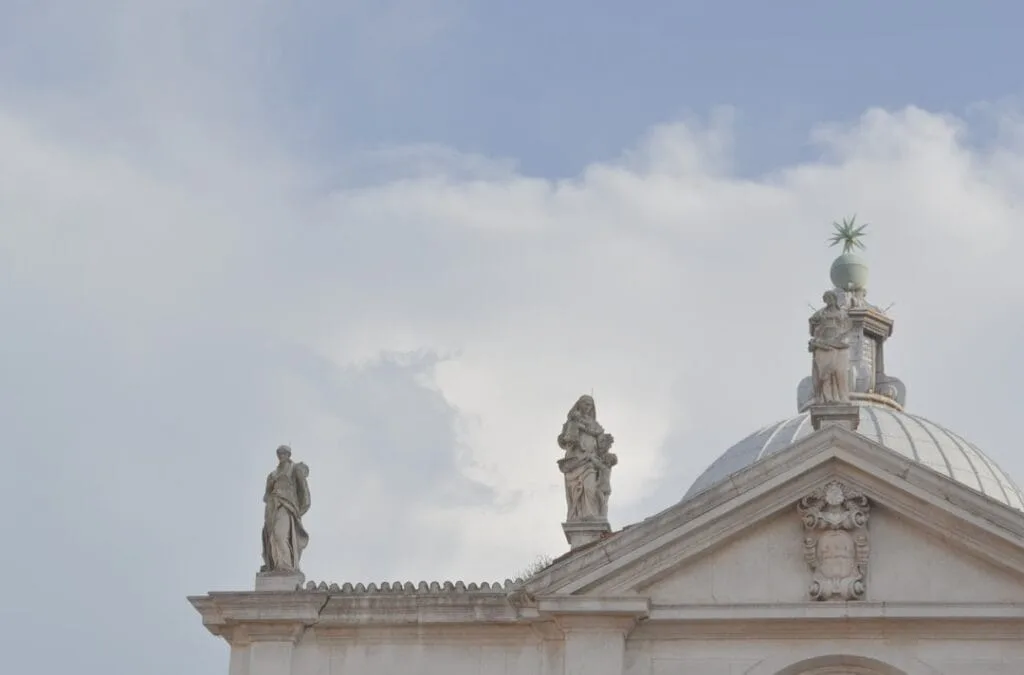






Introduction: the symbol that dominates Rome and Christendom
The St. Peter’s Basilica, in Italian Basilica di San Pietro in Vaticano, is one of the most iconic churches in the world. Located in the heart of Vatican City, it occupies a central place in Rome’s religious, artistic and urban history. Its official address is Piazza San Pietro, 00120 Città del Vaticano, Vatican City. The basilica alone draws millions of visitors every year—pilgrims and sightseers alike—who come to admire its monumental architecture, masterpieces and its direct link to the Apostle Peter, who tradition places beneath the main altar.
The story of this site spans two millennia: from a 1st‑century Roman necropolis to the Constantinian basilica of the 4th century, and then to the massive reconstruction launched in the early 16th century and completed in the 17th century. Renaissance and Baroque masters—Bramante, Michelangelo, Carlo Maderno, Gian Lorenzo Bernini—shaped the silhouette and interior of the building we know today. Every detail, from Michelangelo’s dome to Bernini’s bronze baldachin, tells a tale of artistic ambition, papal power and technical innovation.
The basilica is not just a museum of sacred art: it remains an active house of worship, the setting for major papal celebrations and public audiences. The grand approach from the Tiber, Via della Conciliazione, 00193 Roma RM, Italy, opens onto the majestic Piazza San Pietro. For anyone visiting Rome, the basilica is a must‑see—both for its historical weight and for the emotional impact of its interior proportions and light. In this article we’ll walk through the major stages of its history, decode the works that made it famous and give practical details—addresses, opening times, prices—to plan a thoughtful and respectful visit.
 Click here to book your guided tour of St. Peter’s Basilica
Click here to book your guided tour of St. Peter’s Basilica

1. Origins: ancient Rome, the necropolis and the old basilica
Before the basilica we see today, the Vatican hill site was occupied by an ancient necropolis where, according to Christian tradition, the Apostle Peter was buried after his martyrdom in Rome in 64–67 AD. 20th‑century archaeological excavations confirmed the existence of a necropolis and an honorary tomb beneath the current high altar. The old Constantinian basilica, known as the « Old St. Peter’s, » was built in the 4th century (around 319–333) by the Emperor Constantine I to commemorate this sacred spot.
The Constantinian basilica was a large three‑aisled early Christian church, complete with a long atrium and an east‑facing apse—typical of paleochristian basilicas. For more than a millennium it anchored Rome’s religious life and served as an important pilgrimage center. However, by the 14th and 15th centuries the structure had fallen into disrepair. Renaissance popes, eager to restore the Church’s grandeur, decided to replace it with a new building befitting Rome’s prestige and the papal seat.
In this context Pope Julius II ordered the partial demolition of the old basilica and in 1506 launched construction of a monumental new church. That decision marked the transition from a paleochristian basilica to a Renaissance and Baroque masterpiece, symbolizing a reassertion of Christian heritage in the European landscape.
Click here to book the Vatican undergrounds tour at St. Peter’s
Click here to book the Vatican underground tour at St. Peter’s

2. The Renaissance and the colossal building site: Bramante, Raphael, Michelangelo
The project for the new basilica was one of the Renaissance’s most ambitious building campaigns. Pope Julius II laid the first stone on April 18, 1506, and appointed Donato Bramante as chief architect. Bramante proposed a centrally planned basilica dominated by a massive dome, inspired by the Pantheon and ancient models, with four monumental piers forming a Greek cross. This decision reflected a desire to reconcile Christian tradition with Rome’s architectural legacy.
After Bramante’s death in 1514, several architects followed—Giuliano da Sangallo, Raphael Sanzio, Antonio da Sangallo the Younger—each revising the plans. In 1546 Michelangelo was appointed to lead the project at the age of 71; he simplified the forms, shaped the dome’s silhouette and strengthened the piers. Michelangelo’s dome is a technical and artistic masterpiece: it rises 136.57 meters to its cross (measured from the basilica’s base) and dominates Rome’s skyline, influencing religious architecture across Europe.
After Michelangelo’s death in 1564, Carlo Maderno was commissioned to extend the nave and execute the façade (finished in 1614), converting the plan into a Latin cross and giving the basilica a long processional nave. These changes show how stylistic and functional choices adapted the building to liturgy, processions and papal visibility.
3. Bernini’s Baroque: the baldachin, the colonnades and theatrical grandeur
In the 17th century Gian Lorenzo Bernini conceived the Baroque ensemble that gives the basilica its theatrical language today: the bronze baldachin (Baldacchino) built between 1624 and 1633, a monumental work placed above the papal high altar of St. Peter’s Basilica, and St. Peter’s Square (Piazza San Pietro) with its colossal colonnades executed between 1656 and 1667 at the request of Pope Alexander VII. The baldachin, nearly 30 meters high and made by Bernini using bronze taken from the Pantheon, marks the visual focal point under the dome and emphasizes verticality.
The Piazza San Pietro (Piazza San Pietro, 00120 Città del Vaticano) consists of a central oval embraced by two rows of columns, forming a symbolic hug intended to welcome the faithful. On the eastern side an Egyptian obelisk rises at the center of the square; it was re‑erected in 1586 by Domenico Fontana. The steps, the basilica and the square together form a sacred theater where major papal ceremonies take place.
Bernini conceived the space as theatrical staging: the slope of the square, the alignment of the columns, and the visual opening toward the façade and dome guide the visitor’s gaze. The effect is both majestic and humanizing: the colonnades symbolize the « maternal arms of the Church » embracing the people.

4. Major works, tombs and the necropolis: what to see inside
The basilica’s interior houses unmissable masterpieces. Michelangelo’s « Pietà » (1498–1499) is located in the first chapel on the right after the entrance (Pietà Chapel). This marble sculpture, of exceptional finesse and emotional power, remains one of the main reasons visitors come. The papal high altar sits beneath Bernini’s baldachin and, beneath it—according to tradition and archaeological excavations—lies the tomb of the Apostle Peter.
The basilica also contains numerous papal tombs: that of Saint Peter (partially accessible via liturgical circulation), the tomb of John Paul II (Basilica di San Pietro, Piazza San Pietro, 00120 Città del Vaticano) and many other funerary monuments carved by renowned artists. Visitors wishing to see the remains of the ancient necropolis and the alleged tomb of Peter can book the Scavi Vaticani (excavations) tour. Archaeological Scavi Tours are organized by the Fabbrica di San Pietro and depart from Piazza San Pietro, 00120 Città del Vaticano. Indicative price: €13 per person (reservation fee, limited places). Bookings must be made well in advance via the official Fabbrica website or by email.
Among other highlights, note the monumental mosaic work, statues of the apostles, and remarkable Baroque tombs. Each chapel and funerary monument tells a chapter of papal and artistic history.
Click here to discover Michelangelo’s Pietà and the papal tombs
Click here to discover Michelangelo’s Pietà and the papal tombs

5. Practical visit today: opening times, prices, access and tips
St. Peter’s Basilica is both a place of worship and a very popular tourist site, so it’s important to know the practical details before you go. General opening times (subject to seasonal changes): the basilica is typically open from 07:00 to 19:00 from April to September and from 07:00 to 18:30 from October to March. The dome has separate hours: usually open from 08:00 to 18:00 (last elevator ascent around 17:00, last stair ascent around 18:00). The main entrance address remains Piazza San Pietro, 00120 Città del Vaticano.
Prices and tickets: entry to the basilica itself is free, but queues and security checks are routine. Climbing the dome costs money: approximately €10 for the elevator + 320 steps (partial elevator option), or €8 for the full 551‑step staircase (indicative 2024 prices). The Scavi Tour (necropolis) is paid (around €13) and requires prior reservation. The Vatican Museums (Musei Vaticani) are next door and worth combining with your visit (address: Viale Vaticano, 00165 Roma RM, Italy); indicative ticket price: €17 (standard online ticket, 2024), opening hours: 09:00–18:00, last entry 16:00, closed on Sundays except the last Sunday of the month (free entry 09:00–14:00, last entry 12:30).
Practical tips: dress respectfully (shoulders and knees covered), since a dress code is enforced at the entrance. Avoid peak hours—early morning or late afternoon—to reduce waiting time at security checks. The dome climb is physically demanding; choose the elevator option if you have mobility issues. Paid audio guides and guided tours (usually between €25 and €50 depending on the formula) are available and help contextualize the artworks and the site’s history.
Click here to climb the dome and visit the papal tombs
Click here to climb the dome and visit the papal tombs
Click here to book your Vatican Museums & Sistine Chapel tickets
Click here to book your Vatican Museums & Sistine Chapel tickets

Conclusion: memory, faith and preservation for centuries to come
St. Peter’s Basilica remains a living masterpiece: a religious sanctuary, an art museum and a witness to major architectural developments. Its history—from the ancient necropolis to the Renaissance building site and Baroque additions—illustrates how Rome and the papacy have used art and architecture to express faith and authority. Today’s visits are part of that ongoing story: millions of visitors each year discover the volumes, sculptures and tombs that make the site so rich.
Preparing your visit means checking addresses and practical information: St. Peter’s Basilica – Piazza San Pietro, 00120 Città del Vaticano, Musei Vaticani – Viale Vaticano, 00165 Roma RM, Italy, and Via della Conciliazione, 00193 Roma RM, Italy as the main approach. Always verify official opening hours and ticket prices in advance on institutional websites to avoid surprises. Beyond the numbers and the artworks, the basilica offers a unique emotional experience—mixing silence, grandeur and beauty—a memory in stone and faith that still speaks to 21st‑century visitors.