





Introduction
Rome is a city where every stone tells a story, but few places capture the history of art and faith as potently as the St. Peter area. At the heart of the Vatican City you’ll find an extraordinary concentration of works — sculptures, architecture, mosaics and frescoes — created by masters like Michelangelo, Gian Lorenzo Bernini, Raphael and others. Whether you’re an art lover, a pilgrim or simply a curious traveler, visiting St. Peter and the Vatican delivers a succession of visual and spiritual highs, from the basilica’s grand exterior to the subterranean sanctuaries of the necropolis.
This guide highlights the must-see works located around the basilica and inside the Vatican Museums, with all the practical details: exact addresses, opening hours, prices in euros and tips to make the most of your visit. The goal is to help you plan your route, spot the major pieces (like Michelangelo’s Pietà or Bernini’s Baldachin), and know exactly where to find them, how to access them and what they’ll cost.
You’ll also find recommendations to avoid peak times, dress‑code rules and visit options (climb the dome, tour the necropolis, or book a guided visit of the Vatican Museums and the Sistine Chapel). Each section gives practical info and detailed descriptions of the works so your visit can be both smooth and deeply rewarding.
Before you go, note that the area is subject to systematic security checks and that many spaces are free (the basilica itself and St. Peter’s Square), while others require a reservation or paid ticket (museums, the dome, scavi). Take a few minutes to read the logistical tips below — they’ll save you time and enhance your experience of the artworks.
Basilica of St. Peter: architecture, access and major works
The Basilica of St. Peter (Basilica di San Pietro in Vaticano) sits at Piazza San Pietro, 00120 Città del Vaticano. It’s the Vatican’s focal point: a colossal volume, a monumental façade and a dome designed by Michelangelo that dominates Rome’s skyline. Entrance to the basilica itself is free, but you’ll still go through the same security screening used for the Vatican Museums.
Opening hours:
- Basilica of St. Peter: generally 07:00–19:00 (April–September) and 07:00–18:30 (October–March). Times may change for liturgical events.
- St. Peter’s Square (Piazza San Pietro): usually accessible most of the time, often open 24 hours, but restrictions can apply during papal ceremonies.
- Dome (Cupola): typically 08:00–18:00 in high season, 08:00–17:00 in low season; the last ascent is allowed 30 minutes before closing.
Prices (indicative):
- Access to the basilica: free.
- Ascent to the dome: €10 (lift + stairs) / €8 (stairs only). Rates may change.
Inside, don’t miss Bernini’s Baldacchino, a monumental bronze canopy that marks the high altar and stands directly under the dome. The weight of the baldachin contrasted with the light pouring down from the dome creates a striking focal point. Further toward the apse you’ll find Bernini’s Cathedra Petri (Chair of Saint Peter), a monumental reliquary surrounded by sculptures, gilding and a spectacular play of light.
Practical tips: arrive early (or late afternoon) to avoid the crowds, dress respectfully (shoulders and knees covered) and expect security checks that can cause queues, especially in high season.
 Click here to book your guided tour of St. Peter’s Basilica
Click here to book your guided tour of St. Peter’s Basilica

Michelangelo’s Pietà: history, location and details to notice
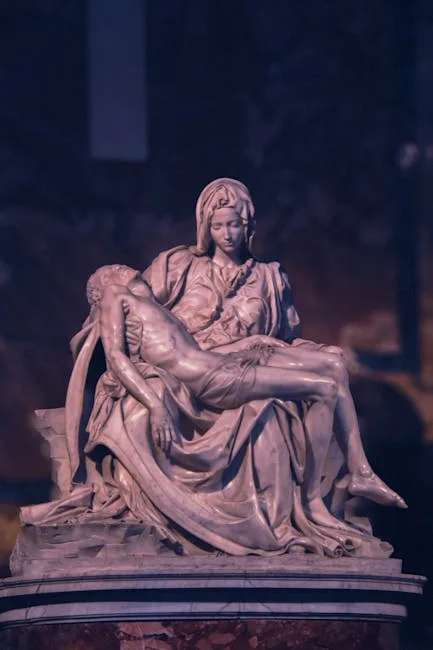
Michelangelo’s Pietà is arguably the most visited work inside the basilica. It’s displayed in the Pietà Chapel to the right after the main entrance of the basilica. Exact reference: Basilica of St. Peter (Piazza San Pietro, 00120 Città del Vaticano), Pietà chapel, first right lateral bay.
Description and details: carved in marble when Michelangelo was just 24, the Pietà shows the Virgin Mary holding Christ’s body after the crucifixion. Michelangelo chose to depict Mary as young and serene, with elaborate drapery that elevates the stone. The work is protected behind a bulletproof glass case due to past attacks; this limits close contact but allows careful study of the chiseling, the polish and the facial expressions. Look for the hidden signature on the sash across the Virgin’s chest: “MICHEL-ANGELO BUONARROTI” — a rare instance of the artist signing a religious work.
Hours and access: accessible during the basilica’s opening hours (see previous section). Viewing is free but often very crowded; during peak times access to the chapel may be regulated to protect the sculpture and visitor safety.
Observation tips:
- Approach slowly and favor the natural light coming from the nave to distinguish shadow lines.
- Examine the treatment of the drapery and the delicacy of the hands: Michelangelo rendered flesh and fabric with equal sculptural intensity.
- Keep the scale in mind: the Pietà is life‑sized, but its polished surface amplifies the sense of monumentality.
Click here to discover Michelangelo’s Pietà with a guide
Click here to discover Michelangelo’s Pietà with a guide

Bernini’s Baroque masterpieces: the Baldachin, the Chair and the Colonnade
Gian Lorenzo Bernini is the sculptor‑architect who left an unmistakable mark on St. Peter and its square. His creations operate on several levels: interior works (the Baldachin, the Cathedra Petri, funerary monuments) and exterior arrangements (the colonnade that frames the piazza). Shared address: St. Peter’s Basilica / Piazza San Pietro, 00120 Città del Vaticano.
The Baldacchino di San Pietro is an enormous gilded bronze canopy located in the center of the transept, directly under the dome. Built between 1624 and 1633, it marks the presumed tomb of the Apostle Peter and establishes a monumental link between the papal altar, the dome’s vertical axis and the basilica’s spiritual verticality. The gilding, the twisting columns and the symbolic ornaments (bees, flowers and papal insignia) are hallmarks of the Baroque: drama, storytelling and material abundance.
The Cathedra Petri in the apse is a relic encased within Bernini’s sculptural ensemble, composed of putti, cloud forms and symbols that frame the reliquary chair. The visual effect — a simulated ray of light within a gilded ellipse — is designed as a celestial manifestation validating papal authority.
Outside, Bernini’s Colonnade is an urbanistic feat: two rows of columns forming an ellipse that seem to open the Church’s arms. The colonnade defines St. Peter’s Square and leads visitors toward the basilica while creating striking perspective effects and crowd dynamics. Statues of saints, the central Egyptian obelisk and fountains punctuate the space.
Practical tips: the square and the basilica are free to access, so you can admire these masterpieces without a ticket. To better understand Baroque symbolism, consider a guided tour or an audio guide. Bernini’s trademark plays of light and shadow are most readable in the morning and late afternoon, depending on the sun’s angle.
Click here to visit St. Peter’s Basilica with full access
Click here to visit St. Peter’s Basilica with full access
The Vatican Museums and the Sistine Chapel: route, prices and highlights
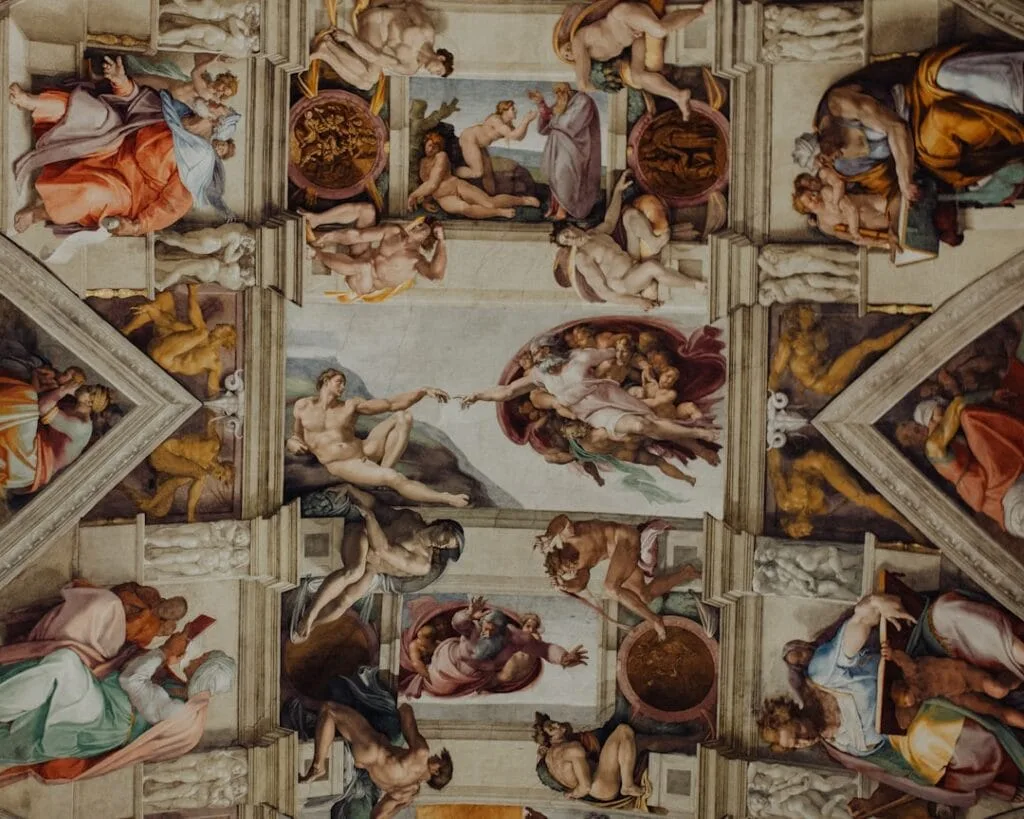
The Vatican Museums (Musei Vaticani, Viale Vaticano, 00165 Roma RM, Italy) form one of the world’s largest museum complexes. They house a collection spanning Roman antiquity to Renaissance masterpieces. The classic route takes you from the Cortile del Belvedere to the Pinacoteca, through the Gallery of Maps (Galleria delle Carte Geografiche), Raphael’s Rooms (Stanze di Raffaello) and finally the famous Sistine Chapel (Cappella Sistina) with Michelangelo’s frescoes.
Opening hours:
- Generally 09:00–18:00 (last entry around 16:00). Closed on Sundays except the last Sunday of the month (free entry from 09:00 to 14:00, last entry 12:30).
Prices (indicative):
- Standard ticket online: €17.
- Online booking fee: often €4 (varies by channel).
- Audio guide: around €7.
- Guided tours (variable prices): from €30 to €60 depending on length and language.
Must‑see works:
- The Sistine Chapel: Michelangelo’s ceiling and The Last Judgment (silence required).
- Raphael’s Rooms (Stanze di Raffaello): Raphael’s frescoes, especially the Stanza della Segnatura.
- Gallery of Maps (Galleria delle Carte Geografiche): monumental cartographic frescoes.
- Museo Pio‑Clementino: the Laocoön and his sons, the Belvedere Apollo.
Practical tips: buy tickets online to skip the queues; the visit is long (allow 2 to 4 hours depending on interest). The Sistine Chapel requires silence and forbids photography: respect these rules to help preserve the frescoes.
Click here to book your Vatican Museums & Sistine Chapel tickets
Click here to book Vatican Museums & Sistine Chapel tickets
The Scavi and the Vatican Necropolis: a visit beneath the basilica
For those seeking a unique archaeological experience, the scavi (Vatican necropolis) deserves a spot on your list. This ancient burial area beneath the basilica contains traces of St. Peter’s tomb and a network of early Christian graves. Access is strictly controlled and available only via a guided tour organized by the Ufficio Scavi. Meeting point: Ufficio Scavi, Piazza San Pietro, 00120 Città del Vaticano (welcome and start point indicated when you book).
Price and booking:
- Indicative fee: €13 per person (standard price for the official guided tour).
- Reservation required in writing or via the Pontifical Commission of Sacred Archaeology’s official site; places are limited and groups are very small (often about a dozen people maximum).
- Tours mostly run in the morning and last about 1 hour.
Content and access: the tour takes you through archaeological layers, mausoleums and inscriptions that shed light on the development of the cult around the Apostle Peter’s tomb. Given the site’s historical importance and fragility, the route is restricted and photography may be limited. Book well in advance, especially in high season.
Practical tips: wear comfortable shoes (uneven floors), follow the guide’s instructions, and remember the environment is confined and can be cool. For anyone wanting to see Rome underground and the site’s historical continuity, it’s an unforgettable experience.
Click here to book the guided tour with access to the underground areas
Click here to book the guided tour with underground access
Conclusion
St. Peter and the Vatican are a true concentration of Western art. Between the architectural majesty of St. Peter’s Basilica, the sculptural tenderness of Michelangelo’s Pietà, the theatrical energy of Bernini’s Baroque works, the museum riches of the Vatican Museums and the historical depth of the Scavi, each visit offers a different perspective on history, theology and aesthetics. The practical information provided — addresses, hours and prices — will help you plan a calmer, more rewarding visit.
To recap the essential tips: book your Vatican Museums tickets online, arrive early at the basilica to enjoy the works in quieter conditions, consider climbing the dome if you can manage the steps (or use the partial elevator), and if possible reserve the Scavi tour well in advance. Finally, respect the rules of reverence and conservation: keep silent in the Sistine Chapel, dress appropriately in the basilica and be mindful around fragile works.
Whether your visit is spiritual, artistic or historical, St. Peter will offer memorable scenes and details to study that will resonate long after you leave Rome.